Native artists reclaim their stories in new R.I. exhibit ‘Ascending: The Liberation of Native Art’
The Boston Globe | July 7, 2026
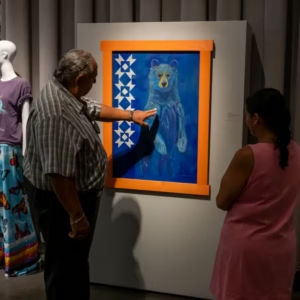
PROVIDENCE — Artist Brooke Waldron focuses her work on nature, specifically animals that wander into her yard or she feels a deep connection to. As a painter, she utilizes bold color palettes with a keen eye that seems to convey the creatures’ souls through two-dimensional imagery.
“We say our four-legged relatives or our two-legged or winged relatives,” she said. “I have a very deep love for wildlife.”
Waldron is a member of the Seaconke Wampanoag Tribe with Narragansett lineage based in Hope Valley. She’s also the founder of Cedar Nation, a nonprofit organization that works with intergenerational tribal members from across the Northeast to build community, spread knowledge about Native American history and practices, and elevate their art.
She established Cedar Nation to build “ a collective that feels a little more authentic to how our communities operate” — it’s collaborative and celebrates diverse perspectives. The organization is also a vessel for Waldron to write grants to help fund more Native art exhibitions.
“It’s astounding to me that you can walk into an art museum in Massachusetts or in Rhode Island, and there is not a Native art section, but there is an American section that almost never holds Native art,” Waldron said.
Waldron initially curated “Ascending: The Liberation of Native Art” — an exhibition of contemporary Native American art — at the Alexey von Schlippe Gallery of Art in Groton, Conn.
The exhibition is on display at the WaterFire Arts Center in Providence through Aug. 30 along with “America, Unfinished?!,” a contemporary exhibition from artists across the country ruminating on identity, democracy, belonging, memory, justice, and civic life.
“Ascending” includes works by seven Native artists — Waldron, Julia Marden, Joshua Carter, Allen Hazard, Kathy Atkins, Miciah Stasis-Harding, and Scott Strong Hawk Foster — that exemplify generations of Native traditions and knowledge as well as the impact colonization continues to have on society. The works include contemporary portraits, beaded moccasins, and even a traditional dugout canoe on loan from the Mashantucket Pequot Museum and Research Center in Mashantucket, Conn.
“There’s some of us that are just the most incredible, astounding wampum artists or weavers, and then there’s some of us that are painters, and it would be unlikely that you would see a show with two of those things near each other,” said Waldron.
Wampum are beads formed from quahog and channeled whelk shells. They were traditionally strung and often woven into belts to signify important relationships, record keeping, rank, or special occasions.
“To this day, it’s one of the best ways to say thank you to somebody,” said Carter.
He is a member of the Mashantucket Pequot Tribal Nation and previously served as the executive director of the Mashantucket Pequot Museum and Research Center. Carter also sells quahog jewelry at The Purple Shell in Charlestown, R.I. However, he doesn’t create any pieces with beads for the shop.
“Wampum is literally considered to be animate and alive, so the actual holding of those belts was really important,” he said. “ I’ve made I don’t know how many traditional beaded necklaces, but they’ve all gone to relatives as gifts.”
After his cousin passed away, Carter channeled his grief into establishing a relationship with the quahog shell and creating wampum. He turned to Hazard, a fellow artist and a Narragansett Indian, who took him under his wing.
“A really important value in our community is a teacher-student role that we play,” said Carter. “If you’re fortunate enough, you’re a student for a while, but once you learn, you have this responsibility to teach.”
Carter and Hazard worked together on a ceremonial-style pipe for smoking with inlaid quahog pieces called “Gift for my Grandchildren” that is on display in “Ascending.”
“For tribal communities, the relationship has to come first, and then we have the potential to do work together,” said Carter.
On the exterior of the WaterFire Arts Center, visitors can experience five large-scale portraits by photographer Foster. They are half of a collection of 10 portraits originally installed at Faneuil Hall Marketplace in Boston as part of the city’s “Un-Monument | Re-Monument | De-Monument” initiative.
Foster, who hails from the Hassanamisco Nipmuc Band, a tribal entity based in Worcester, captured striking images of Native people in their regalia. Set against a black backdrop, their compelling expressions and garments tell their stories, Foster said.
Although he didn’t realize it at the time, Foster’s series “Ways of My Ancestors: Imagery — Lighting the Path to Awareness” began when he was 15 years old, learning about King Philip’s War in class. He remembers flipping to the assigned page in his textbook to find only one image.
“It was of a Native man or warrior at the time, standing over a female settler who had blonde hair and blue eyes … on her knees, begging for her life,” said Foster. “He had his hand wrapped around her hair, pulling it up, with a tomahawk in the other hand, getting ready to strike her, and there was a burning cabin in the background.”
From 1675 to 1676, King Philip’s War was the direct result of colonists resisting peaceful coexistence with the Wampanoag and other tribes. English settlers continued to seize more land and control over Native people, so they fought back. Thousands of colonists and Natives died; and after the war, colonists sold many Natives into slavery and continued to take land.
When Foster was giving a pitch to curators at the Worcester Art Museum, he recalled that image and began tearing up. He didn’t understand how much this evil depiction affected him until that moment.
Through his work, he realized he could take back that hateful narrative.
“I had control. I could remove that burning cabin,” he said. “I can portray us in the way that we really are, in our regalia, standing proud and stoic.”
Waldron explained that the 250th anniversary of the United States is complicated for Native people.
“America is a little tiny young shoot of an acorn. The historical and cultural footprint that predates America, it’s systematically left out,” said Waldron. “Colonization hurts everybody because it requires the subjugation of others. There is a power dynamic that must exist.”
Still, she explained that many Native people are very patriotic. In fact, Native individuals serve in the armed forces at five times the national average, according to the US Department of Veterans Affairs.
“Native folks, we love this land,” said Waldron. “It is a relative to us.”
As it pertains to the art museum world, Waldron explained that curators need to listen to Native communities instead of defining their work and stories for themselves.
“I would like to tell you what our community work is, and I’ll teach you about it,” she said, “and then you make space for it.”