‘Art just flowed out of him’: Brookline artist John Wilson’s powerful legacy on display in new MFA exhibition
Brookline.News | February 11, 2025
Every summer community members in Roxbury gather to wash “Eternal Presence ,” a seven foot bronze head maquette outside the National Center for Afro-American Artists. Adults soap up the face of the sculpture affectionately known as the “Big Head” while kids enjoy cleaning out the ears, polishing a legacy erected by a member of their own community.
The late John Wilson created the sculpture, drawing inspiration from the Olmec heads — huge stone sculptures from the Olmec Civilization likely depicting high ranking members of society. Instead of portraying a specific individual, “Eternal Presence” is meant to represent anyone and everyone in the Black community.
Wilson, who was born in Roxbury and lived in Brookline for 51 years, died in 2015.
“Witnessing Humanity: The Art of John Wilson ,” the largest-ever collection of his work, opened on Feb. 8 at the Museum of Fine Arts in Boston, in collaboration with the Metropolitan Museum of Art. The solo exhibition features 110 works, including prints, drawings, paintings, sculptures and illustrated books.
The exhibition catalogs over 60 years of Wilson’s career, from studying at the School of the Museum of Fine Arts to creating the bronze bust of Martin Luther King Jr. that sits in the U.S. Capitol Rotunda in Washington D.C. A different bronze maquette of MLK sits in Brookline Town Hall — a committee dedicated to honoring Wilson raised $100,000 to purchase and install the piece in 2019.
A ‘sweet’ man with art fueled by anger
Wilson’s children Erica and Roy Wilson sat at Erica’s dining room table near Coolidge Corner during a recent interview with Brookline.News, looking around at etchings and drawings created before and after the sculpture hanging on the surrounding walls. Erica gazed at a drawing from 1972 of Wilson’s initial idea for a monumental head with a closed mouth. “He wanted the piece to have an inner soul, and if the mouth is closed, it’s not communicating, so the mouth is open,” she said.
“Eternal Presence” stares at the viewer as if to say, “You will not f—— ignore me,” Roy said.
The piece exemplifies Wilson’s mission as an artist: To bring Black people into spaces where they weren’t previously given space and to depict the multifaceted sides of humanity.
Wilson raised his children in Brookline with his wife Julie. He was Black and Julie is white, and they married in 1950 before the Civil Rights movement began.
Julie, who is 97 and still lives in Brookline, remembered her husband for his honesty and sensitivity. “He was a sweet guy. I was very lucky to be married to him,” she said.
Wilson was a kind and loving father, telling stories of a magical winged horse named Grease Lightning and constructing sculptures out of Play-Doh with his children, said Erica. But he was also angry.
“He was an angry man because almost any Black man of that generation was an angry, angry man because they should’ve been,” said Roy.
“Race was an inescapable understanding,” Erica added. “It was a part of my understanding of myself and my family’s understanding of who we were in the context of Brookline.”
She referred to Boston’s Busing Crisis in 1974 and her own personal accounts of racism in the community, like when a neighbor let all of the white kids play in their backyard pool but not her.
“His ethos, I think, came from his community and his family and experiences he had as a young person and growing up the time that he grew up,” said Erica of her father. “He was born in ‘22 and so in the ‘20s and ‘30s, Black people were being lynched all over the country, and so there’s a real sense of violation and danger.”
Wilson captured this danger and fear in “Study for the mural ‘The Incident’ ” (1952), which is on display in the exhibition. This watercolor, ink and graphite work illustrates a mother protecting her child from a Black man being lynched by members of the Ku Klux Klan, while a father looks on at the horrific scene with an angry, determined gaze and a gun in his hand.
Wilson’s work runs the gamut from capturing intense, racist violence, to seemingly banal moments like people sitting in waiting rooms, to tender scenes of familial love and care.
Erica said her father drew fervently and brought index cards wherever he went to sketch.
“I broke my arm at one point, and I was at Children’s Hospital, and he had got these pipe cleaners, and he sculpted — I desperately wish I still had it — this three dimensional horse kind of creature that hung from my ceiling for years and years and years,” said Erica. “Art just flowed out of him. It felt like he didn’t have control over it.”
An advocate for education
In Julie’s home, an early casting for “Father and Child Reading,” a sculpture also featured in the exhibition, sat on a long wooden table surrounded by other castings, drawings and paintings. The sculpture depicts a father reading to a young child on his lap. It became a symbol of education and tenderness when it was unveiled on campus at Roxbury Community College in 1990.
Wilson was a big proponent of education. He moved to Brookline with his family for the school system, even though it meant living in a majority white neighborhood and a town where his mother used to clean houses. He was a professor of Fine Art at Boston University for 20 years and instilled the importance of learning in his children, like his father did for him.
His parents immigrated to the U.S. from British Guiana, now Guyana, and dealt with racism that limited their ability to secure jobs, compounding the impacts of the Great Depression. His mother supported his family as a domestic worker, and his father raised him and his siblings.
When Wilson created “Father and Child Reading,” he initially thought it was about his own children, but later realized it paid homage to his parents.
“He talks about this sculpture as being at its heart, a loving remembrance of his parents and how they inculcated in him the importance of reading. And so for us, it was really critical to do that very thing in this exhibition,” said Edward Saywell, co-curator of the exhibition and Chair of Prints and Designs at the MFA.
The exhibition also includes a “Book Nook” where visitors can read works Wilson drew inspiration from and children’s books he illustrated like “Becky,” which was written by Julie about his daughter.
How the new exhibition came to be
In developing the exhibition, Boston art gallery owner Martha Richardson was the first person the MFA and the MET called. She was first introduced to Wilson’s work in 1988 when she started working at a small auction house. Someone brought in his 1970 color lithograph “Father and Child ,” and she was in awe.
“I’m getting the goosebumps right now that I got when I saw it,” she said. “It is this remarkable print of a father holding a child, big, protective hands around the child, and I had a visceral reaction to it. And so from that moment on, I was always on the lookout for John Wilson.”
Richardson started showing Wilson’s work in 2010 and became a historian of his art, befriending him and his family and preserving his story. Some of that preservation included sifting through art Wilson shoved under beds and in closets. She developed the full chronology of the exhibition catalogue “John Wilson: Witnessing Humanity.”
Erica and Roy visited the exhibition with Julie before it opened and took in the intimacy of themselves and their friends and family hung on the gallery walls. Erica felt particularly touched by the paintings of her late sister Becky. “There’s pictures of my sister who we love and miss. I guess we’re all central in some ways to our family, but she was, at least in my life, one of those really central people, and so that was moving.”
Many early viewers of the exhibit have had strong emotional reactions to Wilson’s work, according to Saywell.
The exhibit resonates with viewers in part because of the “fragility of the Black family at that time,” explained Leslie King Hammond, co-curator and founding director for the Center for Race and Culture at Maryland Institute College of Art. “In spite of this fragility, the Black family became one of the most resilient forms of kinship and bonding in the American story, and this is one of the heralding factors of his narratives. Every one of these subjects that you see is someone that he knows.”
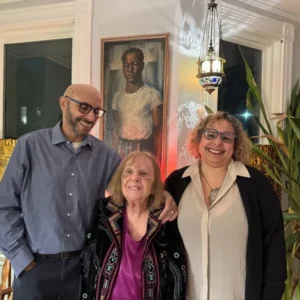
Erica, Roy, and Julie posed for a photo with one of Wilson’s self-portraits in their living room. On a table underneath the painting sat a photograph of John and Julie smiling on their wedding day, the day when their family and story began.