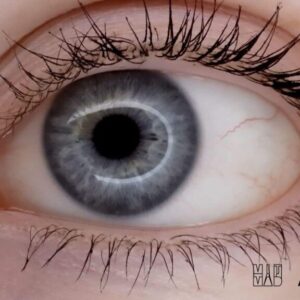
MIT’s ‘Gaze to the Stars’ is all in the eyes
WBUR | March 12, 2025
It’s not everyday that you look up and see a 75-foot eye.
On March 12-14, anyone walking around Massachusetts Institute of Technology at night will see illuminated projections of eyes staring back at them from the top of the MIT Dome.
The project, called “Gaze to the Stars,” is the work of Behnaz Farahi, the director of MIT Media Lab’s Critical Matter Group. Her team of 11 students and an independent contractor developed an immersive pod where people can share their stories with an AI guide.
Participants enter the open air pod and sit on a stool as fog fills the ground. They press their foreheads against a white orb. When they peer inside, they see stars dancing across a night sky.
An AI voice speaks to them: “ Welcome to Gaze to the Stars. I am the MIT Dome, standing quietly here for 109 years. Over the decades, I’ve witnessed countless souls pass beneath my arch. They’ve carried their joys, burdens, and yearnings.”
This voice is more soothing than Siri. It’s gentle and meditative for a therapeutic exchange.
As they settle in, they hear anonymous stories ranging from hope to despondency.
One voice exclaims, “I’m so excited. I’m proposing to my girlfriend of six years.”
Another says, “I find myself lost here, where everyone seemed to grasp things instantly, while I struggled to keep up.”
The AI voice asks them to take a moment and answer a question. There are four different prompts that randomly alternate, asking about dreams, longing, feelings and struggles.
Research assistant Krystal Jiang tested out the process, so I could record the anonymous experience.
The AI voice asked, “What have you been feeling lately?”
“I think I’ve been feeling a little tired, but I think it’s a good type of tired because it means that I’m actually working hard and challenging myself,” Jiang said.
The AI processed and responded, “It’s beautiful to hear that you’re recognizing the value in your efforts and embracing the tiredness as a sign of meaningful progress.”
Jiang’s story is then transcribed and encoded into an image of her iris. Later, the image of her eye will be projected on the MIT Dome. Passersby will be able to scan it with their phone camera and follow the link to her story.
“ It’s really heartwarming to see that people are willing to share their story and to talk about things that maybe aren’t really easy to talk about maybe to like another person, to another face,” she said.
Farahi is a trained architect originally from Iran. She works along the intersections of fashion and technology to explore feminism, emotion, the body and social interaction. Farahi collected 200 stories for “Gaze to the Stars” to learn more about the human experience, from wishes for the future to present heartache.
“ It’s very important to not only just look at the shiny, successful stories of dreams, but also mix it with the stories of struggles and longings and setbacks,” Farahi said.
“Gaze to the Stars” is part of MIT’s inaugural art and technology festival Artfinity. Alix Aubert, a visiting student researcher, tried out the experience. She said having AI ask about deep emotions was frightening but also beautiful.
“The fact of recording eyes while you’re thinking about something that really matters and touches you, I think that’s beautiful because people always say you see what people are feeling in their eyes, so that’s beautiful that we can see that properly,” Aubert said.
The project is about data collection, but at its heart, Farahi said it shows people that we’re not all that different.
“This is an incredible time to really use art and technology, not to just create something which is provocative, but also have meaningful experience to share stories that matters,” she said.
In the future, Farahi hopes to develop portable versions of this experience to send to people across the globe.
For now, she’s helping tell the stories of Greater Boston.